How to Fix Index Bloat and Recover SEO Rankings
Search engine log file studies reveal that enterprise websites regularly lose up to 60% of their crawl resources to URLs that generate zero organic clicks. While teams focus on launching new pages, search bots waste time crawling auto-generated parameters, orphaned tags, and outdated archives.
Index bloat happens when a website allows thousands of low-value or duplicate URLs to enter Google’s search index. This directly suppresses organic rankings by exhausting crawl capacity, diluting link equity, and dragging down your domain-level quality evaluation.
What Exactly Is Index Bloat?
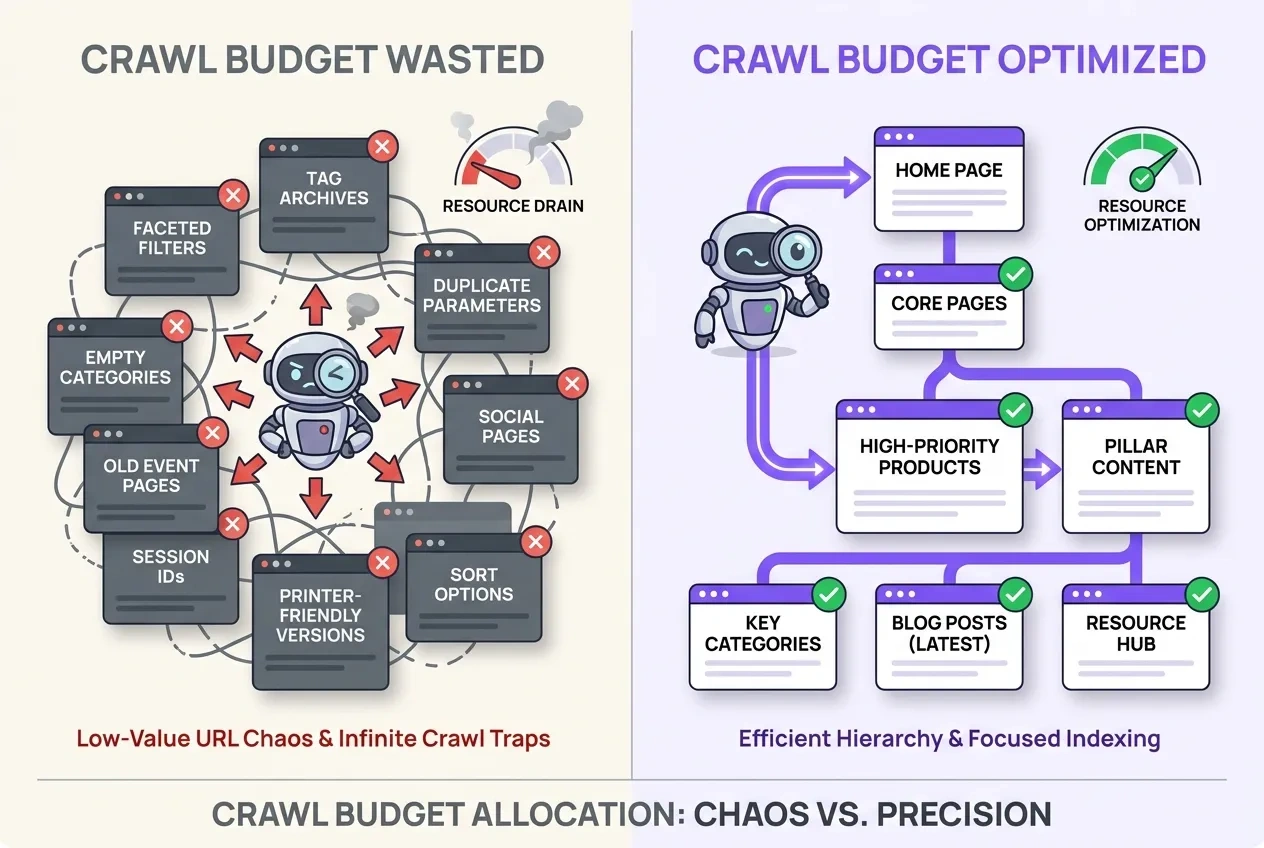
In search architecture, more indexed pages do not equal more keyword visibility. Search platforms calculate two metrics: crawl capacity limit (how many simultaneous requests your server handles) and crawl demand (how frequently algorithms believe your content deserves re-checking). Together, they determine your crawl budget. Official documentation on Google Crawl Budget Management confirms prioritizing high-value URLs is essential.
When search bots encounter thousands of near-empty taxonomy pages or sorting parameters, these low-value URLs compete directly with your pillar guides for indexing priority.
Blocking noindexed pages in your robots.txt file prevents search engines from crawling the page to read the noindex directive, leaving those low-quality URLs permanently stuck in the search index.
The 4 Hidden Culprits Behind Uncontrolled Index Growth
Most websites do not intentionally publish junk pages. CMS configurations and historical debt create indexation creep.
1. Faceted Navigation and Filter Parameters
When users filter by size, color, and sorting order, web applications generate unique URL strings (/shop/shoes?color=black&sort=price_asc). A single category can spawn 10,000 indexable URL variations offering identical copy.
2. CMS Taxonomies and Tag Archives
Default CMS configurations frequently create distinct archive pages for every author and tag combination. When thin archives outnumber substantive pages, domain authority spreads paper-thin.
3. Internal Search Result URLs
Internal search bars producing indexable /search?q=keyword pages create infinite crawl spaces. Spambots frequently target these to inject toxic URLs into your index profile.
4. Decayed and Cannibalizing Content
Over years, sites accumulate outdated blog posts that receive zero traffic. These legacy articles often target overlapping search intents, causing severe keyword cannibalization.
Export your last 12 months of Google Search Console URL performance data alongside your active XML sitemap. Any indexed URL with zero impressions, zero clicks, and zero referring domains is an immediate candidate for content pruning.
How to Audit Your Website for Low-Value URLs
Diagnosing indexation health requires looking at the gap between what you intend to show Google and what Google actually indexed.
# Quick SERP Discovery Check
site:yourdomain.com
The most telling symptom is a huge discrepancy between your submitted XML sitemap count and your Total Indexed Pages in Search Console.
| Audit Check | Healthy State | Index Bloat Indicator |
|---|---|---|
| Sitemap vs. Indexed Ratio | Indexed count matches sitemap within ±10% | Indexed pages exceed sitemap by 2x–10x |
| Zero-Click Page Share | <20% of total indexed URLs | >50% of indexed URLs earn 0 clicks in 12 months |
| Crawl Stats Distribution | >75% of crawl hits land on primary content | >40% of crawl hits land on parameters or tags |
| Excluded Status Ratio | Clean crawl-to-index conversion | Millions of ‘Discovered – currently not indexed’ URLs |
Identify every URL under the ROT framework: Redundant (duplicate variations), Outdated (obsolete news), or Trivial (thin author archives).
The Pruning Decision Matrix: 410, 301, Noindex, or Consolidate?
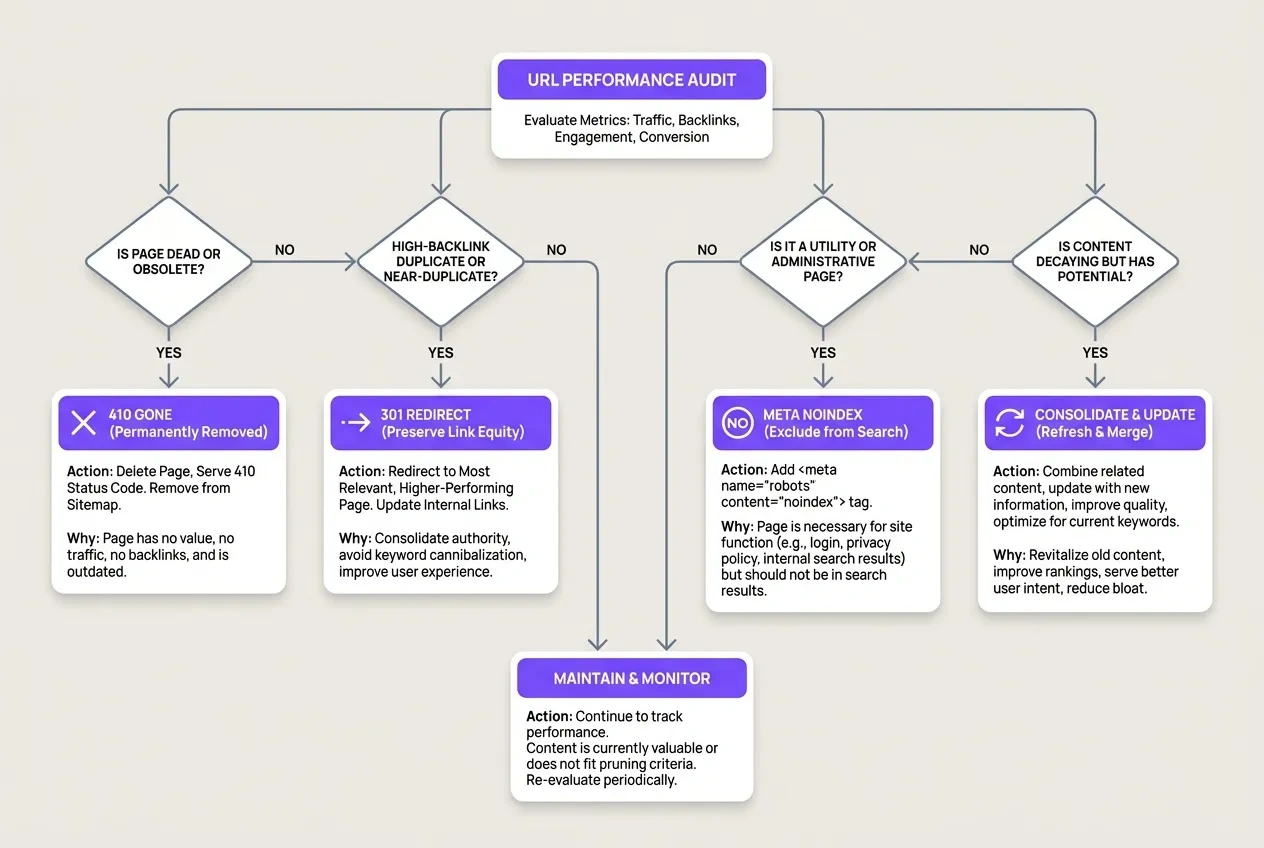
Apply the correct HTTP or meta response to avoid losing backlink equity or causing crawl loops.
1. HTTP 410 Gone (Permanent Removal)
Use 410 Gone for thin, broken URLs with zero backlinks and traffic. It explicitly tells search bots the resource was permanently removed, accelerating de-indexing.
2. HTTP 301 Permanent Redirect (Equity Consolidation)
When pruning an outdated article that holds valuable external backlinks, implement a 301 redirect directly to the most relevant surviving pillar page.
3. Meta noindex, follow (Utility Retention)
Pages serving essential user experience functions but carrying zero search value (login portals, thank-you pages) should be tagged with <meta name="robots" content="noindex, follow">.
4. Canonicalization & Consolidation
Merge the best sections of overlapping articles into a single, comprehensive guide. 301 redirect the weaker URLs into the primary guide to seamlessly pass link equity.
<!-- Example Canonical Tag for Faceted URL Handling -->
<link rel="canonical" href="https://example.com/category/shoes" />
Post-Pruning Maintenance
Preventing future index bloat requires automating technical hygiene:
- Maintain Clean XML Sitemaps: Ensure your sitemaps contain only 200-status, indexable URLs.
- Standardize Parameter Handling: Use server-side canonical headers on dynamically generated tracking parameters.
- Audit GSC Crawl Stats Monthly: Watch the Google Search Console Crawl Stats report to spot parameter leaks early.
- Perform Quarterly Pruning Reviews: Schedule regular content audits every 3 to 6 months to evaluate aging articles and refresh high-potential assets.
By trimming low-value digital clutter, you ensure search bots dedicate their full computational energy to discovering and ranking your most valuable assets.
What is index bloat?
Index bloat occurs when search engines index a large number of low-value, duplicate, or thin pages on your website, which wastes crawl budget and dilutes domain authority.
Should I use 404 or 410 for deleted pages?
Use a 410 Gone status code for permanently deleted pages that have no backlinks or search value, as it tells search engines to remove the URL from their index faster than a standard 404.






Add comment